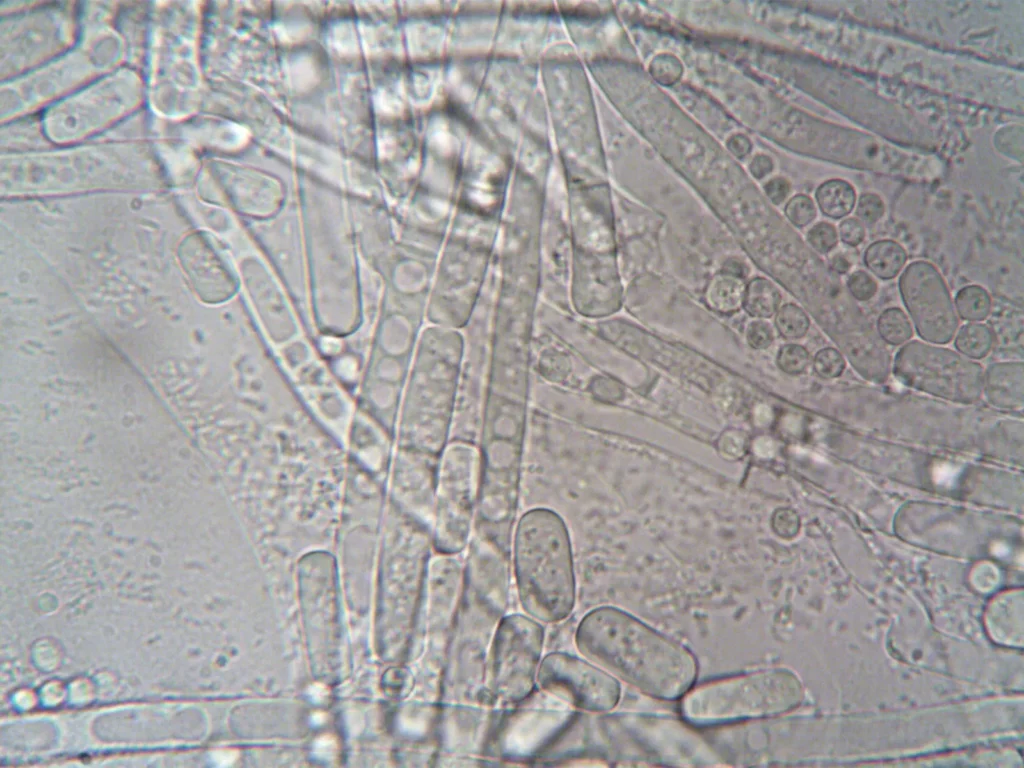
After a mold air sampling inspection, most people receive a laboratory report that looks more like a spreadsheet than an answer. It has sample numbers, air volumes, spore names in Latin, columns labeled “raw count” and “count/m³,” and a few ratings that are easy to skip. This article walks through each part of a typical spore trap report so you can follow the reasoning behind the inspector’s conclusions.
Report layouts differ from one laboratory to another, but most spore trap reports contain the same basic building blocks. Once you know what they are, the numbers become much easier to read.
Key point: A spore trap report is a snapshot of the spores captured in a measured volume of air. There are no federal limits for airborne mold, so the results are read by comparing indoor samples to an outdoor control and to each other, and by weighing them against what the inspector saw and measured on site.
What a spore trap sample is
During air sampling, a pump draws a known volume of air through a small cassette. Particles in the air strike a sticky surface inside the cassette. At the laboratory, an analyst examines that surface under a microscope, identifies the spores and other particles they can recognize, and counts them.
Because the analysis is done by direct microscopy, the report describes what was seen, not what was grown. It counts spores whether they are alive or not, and it groups some spore types that cannot be told apart by appearance. If you would like background on how air samples differ from surface samples, see our article on mold air sampling vs. surface sampling.
The header: sample information
The top of each column or row identifies the sample. Before looking at any spore counts, check that this information is complete and makes sense.
- Laboratory sample number and client sample ID – these link the result to the cassette collected on site and to the chain-of-custody form.
- Sample location – for example “Outside, front porch,” “Basement,” or “Bedroom 2.” Every report should include at least one outdoor sample for comparison.
- Air volume – usually listed in liters. The person who collected the sample provides this value, and the laboratory uses it to convert counts into concentrations.
- Date of collection and analysis – useful when comparing a report with earlier or later testing.
Raw count vs. count per cubic meter
Two numbers usually appear for each spore type, and they mean different things.
Raw count
The raw count is the number of spores of that type the analyst actually counted under the microscope. For a small number of spores, laboratories may count the whole trace. For a heavily loaded sample, they may count a portion and extrapolate, which the report notes.
Count/m³
The concentration, reported as spores per cubic meter of air, is calculated from the raw count, the volume of air sampled and the portion of the sample analyzed. This is the number most people focus on, because it allows samples of different volumes to be compared on the same scale.
A small raw count can turn into a larger-looking concentration after the math. One or two spores of an uncommon type can appear as a noticeable number per cubic meter, so the raw count helps you judge how much weight a result deserves.
Analytical sensitivity
Many reports list an analytical sensitivity or detection limit. This is the lowest concentration that could be reported given how much air was sampled and how much of the trace was read. A result of “not detected” means nothing was seen above that level, not that the air contained zero spores.
Spore types and why some are grouped
The left side of the report lists spore categories. Common examples include:
| Category | What it usually means on a report |
|---|---|
| Ascospores and basidiospores | Broad groups that are common in outdoor air, especially in damp or vegetated surroundings. |
| Cladosporium | A very common genus outdoors; often one of the top outdoor types. |
| Aspergillus/Penicillium | Reported together because the small round spores look alike under the microscope. |
| Stachybotrys and Chaetomium | Types often associated with materials that have been wet for a long time, such as cellulose-based building materials. |
| Hyphal fragments | Pieces of fungal filaments rather than spores; noted separately. |
| Pollen, insect fragments, skin cells, fibers | Non-fungal particles some laboratories record to describe the sample. |
The percentage column, where present, shows each type’s share of the total fungal count in that sample. Percentages help you compare the mix of spore types between indoor and outdoor samples, even when overall levels differ.
Background debris and other ratings
Many laboratories rate how much non-fungal material was on the trace, often on a numbered scale. This rating matters more than it looks.
- A low background rating means the spores were easy to see and count.
- A high rating means dust and particles covered much of the trace. Spores may be hidden, so the laboratory typically notes that counts are minimum values and actual levels could be higher.
Heavy background debris can occur in dusty spaces, during construction, or when a sample runs for a long time. If one of your samples is heavily loaded, ask whether it affects the conclusions.
Comparing indoor and outdoor samples
The U.S. EPA states that no federal limits have been set for mold or mold spores in air. Without a numerical limit, interpretation relies on comparison. An inspector typically looks at questions like these:
- Are indoor totals similar to or lower than outdoor totals? In many buildings without moisture problems, indoor levels track below outdoor levels.
- Is the mix of spore types similar? If the top types outdoors are also the top types indoors, outdoor air is a likely source.
- Do any types appear indoors that are rare or absent outdoors? An indoor type that is elevated compared with the outdoor sample can point toward an indoor source.
- Do indoor locations differ from each other? A basement sample that differs from the upstairs samples narrows down where to look.
No single rule fits every building. Weather, season, recent rain, open windows, HVAC operation and activity in the space all influence results, which is why the inspector’s notes about conditions on the day are part of the interpretation.
What the lab report cannot tell you
Laboratory reports usually include a disclaimer, and it is worth reading. Common limits include:
- The laboratory did not collect the samples and relies on the field information provided.
- Spore traps tend to capture larger spores more efficiently, so very small spores may be undercounted.
- Counts do not distinguish living from dead spores.
- Results represent a few minutes of air at one point in time.
- The report does not diagnose health effects or say whether a space is safe to occupy.
For these reasons, air results are best understood together with a visual inspection and moisture measurements. A musty room with elevated moisture readings in a wall tells a different story from the same air numbers in a dry room.
Putting the report in context
A useful inspection report connects the laboratory data to what was observed: where moisture was measured, which materials showed staining or visible growth, and whether the air results support or contradict those observations. If the results suggest an indoor source, the next step is usually to identify and correct the moisture cause. Peak Environmental of NJ provides inspection and testing only; we do not perform mold removal, so any corrective work would be done by a separate contractor of your choosing.
If cleanup is completed later, follow-up testing can help document conditions afterward. Our mold testing page explains what an inspection includes, and our FAQs answer common scheduling questions.
Questions to ask about your report
- Which sample was the outdoor control, and what were the weather conditions?
- Were any samples affected by heavy background debris?
- Which spore types, if any, were elevated indoors compared with outdoors?
- How do the air results relate to the moisture readings and visual findings?
- Would additional sampling, such as surface samples, add useful information?
If you would like air sampling done or want help understanding a report, you can book an inspection or call (201) 456-7449. Inspections are by appointment.
Frequently asked questions
Is there a safe or legal limit for mold spores in indoor air?
No. The U.S. EPA notes that no federal limits or threshold values have been set for airborne mold or mold spores. Results are interpreted by comparison, mainly against an outdoor control sample and other indoor locations, together with site observations.
Why does my report group Aspergillus and Penicillium together?
Spore trap samples are analyzed by direct microscopy. Spores of these two genera look very similar under the microscope, so laboratories commonly report them as one combined category.
What does a high background debris rating mean?
It means a large share of the sample was covered by dust and other particles. Heavy debris can hide spores, so laboratories usually note that counts on heavily loaded samples should be treated as minimum values.
Does a spore trap tell me whether the spores are alive?
No. Spore trap analysis counts spores and fragments that can be seen under the microscope, whether or not they are viable. It does not grow cultures.
Why was an outdoor sample collected?
The outdoor sample shows what spore types and levels were in the air around the building at the time of sampling. Indoor results are compared to it, because outdoor air is a normal source of indoor spores.
Can one air sample tell me if my house has a mold problem?
Not on its own. Air samples are a snapshot of a short period and can vary with weather, activity and ventilation. They are most useful alongside a visual inspection and moisture readings.
How long does it take to get results?
Turnaround depends on the analysis requested and the laboratory, and it is confirmed when you book the inspection.
Need testing at your property?
Peak Environmental of NJ provides independent inspection and testing only. We collect samples, send them to a laboratory, and explain the results clearly. We do not sell remediation, so our findings are objective.
Related services
Featured image: illustrative stock photography, not Peak Environmental staff or a specific project. This article is general educational information, not legal, medical, or engineering advice.